
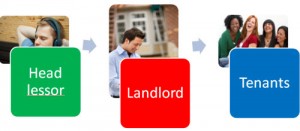
 This is a question to the blog clinic from Kham who is a freeholder / head lessor of a property
I am a landlord and done a rent 2 rent tenancy and are trying to evict the tenant. What are my rights to evict them from court?
The person i rented to has gone to jail, the person he rented to is refusing to leave as the tenancy has already ended.
The management agent took the deposit and never registered it and the tenant is claiming 3 times his deposit back, where do i stand as a freeholder of this property?
Answer:
This is why you need to be so careful about subletting your property on a ‘rent to rent’ basis.
You do not currently have any rights as against the occupier as they are renting from your tenant and not for you. So in order to be able to evict the occupier you need to end the tenancy with your own tenant.
This will probably, whatever is written on the tenancy agreement, be either a common law or a commercial tenancy, as your tenant is not a residential tenant but rented the property from you in order to sublet it.
For example it cannot be an assured shorthold tenancy as they can only exist where the tenant (i.e. your tenant) occupies the property as his home. This is clearly not the case here.
You will therefore need to take legal advice on the proper way to end this tenancy. One good point is that any notices can be easily served on your tenant if he is in prison.
Once this tenancy is ended, if the occupier has a tenancy (which he probably does) his tenancy will continue and you will become his landlord (Housing Act 1988 s18).
You will then have the same rights and obligations towards the occupier as your tenant did. So if the tenant paid a tenancy deposit and it was not protected, then you may need to refund the money to the tenant before you can evict him under the section 21 procedure.
You may also be vulnerable to the claim for the penalty for non compliance in the same way that your tenant was.
You should eventually be able to get your property back but it will not be an easy process and will probably be expensive in legal costs.
The best thing you can do is seek advice from a specialist housing firm such as Anthony Gold.
Note – You can buy a fixed fee telephone advice with a solicitor from Anthony Gold via this page
This is a complicated situation. Going to jail will not end the tenancy with your tenant. If you are not receiving the rent then you should probably go to court for forfeiture to end his tenancy. As part of that claim you could also seek possession as agianst the tenant down the chain. To be safe I would serve him with a section 21 notice first.
The deposit issue is not one that should matter to you. If it the tenant you rented to who is trying to claim his deposit back then he cannot as deposit protection does not apply to his tenancy as it is not an Assured Shorthold Tenancy. If the person who is living there is making that claim then he cannot either as you were not his landlord at the time the deposit was taken so have no obligation to protect it.
You should really seek advice on this case as I am sure there is a lot of detail that is not in your question and would affect the best response to the situation.
As Tessa says, R2R has its advantages and evangelists but it has risks of its own which should be considered with care. You should look for a reputable organisation with the backing of an independent professional body if you are looking for someone to rent your property to in this way.
There are two rent to rent models so clarity is needed first on what contract was written between owner and rent to renter.
If it was a management contract (a modified agency agreement) then the owner is still the occupying tenant’s landlord and so can evict as usual, albeit hampered a bit if he doesn’t have a copy of the AST.
If it was a lease and therefore the rent to renter is the landlord of the occupier then clearly a different scenario.
The owner might well be on the hook re the deposit protection failure if this WAS a management agreement situation.