
 We learned last week that the government is investing £1.4 billion in flood defences in England during 2026/27. As part of its wider preparations for winter weather.
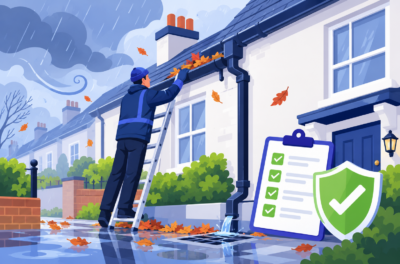
It is a reminder that autumn is the time to check properties before heavy rain, storms, freezing temperatures and flooding become an issue.
This year there is an additional reason to take precautions. Government scientists say that a significant El Niño is likely towards the end of 2026.
Although its effects on UK weather are uncertain, there is an increased chance of stronger winds, stormier weather, heavy rainfall and flooding. Particularly during late autumn and early winter.
So treat this post as a checklist for things you should do now.
1. Check whether your property is at risk from flooding
There are a number of government sites you can use to check. But probably this is the best one as you can check by postcode.
If your property is at risk, give your tenants clear guidance on who to report to in case of flooding. And what emergency arrangements exist locally.
So far as reporting a flood is concerned, see the page here. This gives clear details of what you should do. This is another helpful page.
For local arrangements, check your Local Authority website. They may publish local emergency contacts, flood hotlines, flood action groups, community flood wardens and community hubs. This information could usefully go in an information pack for your tenants.
If your property is at significant risk of flooding, you should also draw your tenants’ attention to the government’s Personal Flood Plan and encourage them to complete one.
See also my earlier post.
2. Carry out a detailed inspection
You should also carry out an extra detailed property inspection before winter. As usual, giving at least 24 hours’ notice and visiting at a reasonable time.
Your inspection should take particular care with the following:
Gutters, drains and external maintenance
For example, check for:
- blocked or damaged gutters and downpipes;
- drains and gullies;
- slipped roof tiles or damaged flashing;
- external cracks or defective pointing;
- trees, fences and loose external fittings that could become dangerous during storms.
Heating, pipes and cold weather
When doing your inspection, you should also check that
- heating systems are working properly;
- tenants know how to operate the heating;
- exposed pipes are adequately protected;
- tenants know where the stopcock is;
- empty properties have appropriate frost precautions.
Remind tenants to let you know if the property is going to be left unoccupied for an extended period over Christmas or during the winter. Particularly where this could affect your insurance arrangements.
You could also remind them about taking precautions. For example, turning off the water at the mains and showing them what needs to be done.
Damp, condensation and ventilation
Winter often reveals problems that were less obvious in summer. So make sure you check:
- extractor fans;
- trickle vents and other ventilation;
- signs of leaks or penetrating damp;
- condensation or mould.
If problems are found, Landlord Law members can check what to do using our Dealing with Damp kit.
If you want guidance on carrying out inspections, Landlord Law members can use our Property Inspection Kit to help with this. Or it can be purchased as a standalone item.
3. Check your insurance
Now (before anything has happened) is also a good time to check your insurance. For example, do you have adequate cover for
- flood damage;
- storm damage;
- burst pipes; and
- periods when the property is unoccupied?
You should also check whether your policy contains conditions requiring regular inspections. Or if it requires you to notify your insurer if the property is going to be left unoccupied for more than a specified period.
4. Emergency contact arrangements
Make sure your tenants know how to
- report an urgent repair;
- who to contact outside normal office hours;
- what to do if water needs to be turned off or there is a power failure.
Landlord Law members will hopefully have incorporated our Repairs Procedure into their tenancy agreement, which will make this more straightforward.
Make sure also that you have up-to-date contact details for your tenants.
5. Vulnerable tenants and the Priority Services Register
If your tenants are of State Pension age, disabled, have long-term health conditions or otherwise need additional support, they may be eligible to join a Priority Services Register operated by their energy supplier or network operator.
Normally this is something that tenants will arrange for themselves if they are eligible. But make sure, if you think they might be eligible, that they are aware of it.
You will find more information here.
6. Keep proper records
Having a proper record system is one of the secrets of being a good landlord and avoiding problems and penalties.
So make sure you keep full details of all your inspection visits, together with photographs, correspondence and telephone attendance notes.
You will find them particularly useful if you have any disputes later with your tenants about the property condition.
And finally
As always, prevention is considerably better and cheaper than dealing with emergency repair work. Or any repair work.
The projected El Niño means that we could be in for a difficult winter. So taking proper precautions will be particularly important this year.
Leave a Reply