
 Here’s a thing sliding through the back door that not many people know about.
Labour MP Karen Buck is proposing a small but perfectly formed change to the law on renting that is going largely unnoticed, probably because it seems like small potatoes but is actually very significant.
Private members bills don’t have a good record. Many of them seemingly aimed at making a name for the proposer rather than a serious attempt to change the law, but every now and again something comes through that actually makes waves and a difference.
Remember the Sarah Teather Bill on retaliatory eviction? It got filibustered out by a couple of rich, land owning MPs but came in through the back door of the Deregulation Act.
This is Karen’s idea:
The Homes (fitness for human habitation) Bill 2015 – 2016 seeks to amend Section 8 of the Landlord and Tenant Act 1985 which relates, unsurprisingly, to the fitness standard of rental property, both at the point of letting and throughout the life of the tenancy.
Section 8 (1 ) states:
“(a) a condition that the house is fit for human habitation at the commencement of the tenancy, and
(b) an undertaking that the house will be kept by the landlord fit for human habitation during the tenancy.”
Section 11 of the Landlord and Tenant Act 1985 is far more widely known, as it relates to the repairing obligations of landlords but section 8 has largely slipped into obscurity because of the restrictive covenants applied to it.
Nearly Legal helpfully provides a guide to said restrictive covenants which originated with the rather patronisingly-titled Housing for the Working Classes Act 1885 and was last amended in 1957 in a way which means that Section 8 only kicks in where the annual rent is less than £80 in London or £52 elsewhere.
The other restriction is that Section 8 also only applies for tenancies of less than 3 years.
Karen Buck’s proposal is to lift the rent restriction and the 3-year limit so that section 8 applies to all tenancies without caveat. This was first recommended way back in 1996 by the Law Commission, but it didn’t happen.
What this would mean at the front end is that tenants could sue their landlords for disrepair under Section 11 and for fitness for human habitation under section 8.
The second reading of the Bill took place on the 16th of October.
Now….all decent landlords reading this will probably think “Why would anyone allow their investment properties to be in a poor state in the first place?” Quite true. Why indeed? But there are a significant minority whose properties are continually run as death traps.
For example, I was recently at a meeting with the London Fire Brigade’s chief fire safety officer, an ex-electrician who is not surprisingly an expert on electrical fires, who told me about a property they attended in March of this year where the tenants reported the smell of burning that turned out to be down to some faulty wiring underneath the floor.
The landlord’s response was to give them a fire extinguisher “In case things got worse”.
Karen Buck’s Bill is for these kinds of landlords, who are surprisingly large in number.
The photographs accompanying this article were taken by me in properties I have visited earlier this year. Both of them were tenanted by people at their wits end trying to get the landlord to do the repairs.
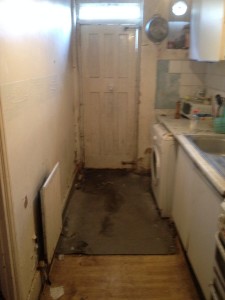
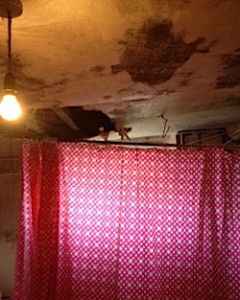 It seems to me, as an ex-rogue landlord enforcement officer that normal landlords would have no problem in supporting the Bill. It won’t cost them anything to usher in or to police and the proposals exclude problems caused by tenant use.
Bear in mind that the repairing covenants are still in section 11 and limited to repairs to the structure of the building so there won’t be any spurious claims of broken washing machines or tatty furniture.
Lets all ‘Back the Buck Bill’…..and if anything deserves to go on a T shirt that is it!
All decent landlords should support this campaign. It isn’t enough to pay lip service to it but do nothing further. A push by landlords to outlaw the rogues who rent out these properties would go a long way to show tenants and would be licensing champions that landlords are supporting plans to tackle the rogues in their community.
We need action, not platitudes and Karen Buck’s fitness for human habitation Bill offers that opportunity to rally support across the sector.
The last thing we need is ‘Buck Bill Platitudes’.
And of course you know how hard I worked to get that pun into this article!
Note – this article was written before the bill had its second reading. Here is a report on what happened.
At the centre of the debate was Philip Davies who talked out the Retaliatory Eviction Bill last year. He is a regular spanner in MPs wheels who wish to bring in legislation that he does not like. He was the second speaker and immediately stated that he had a lot of material to get throughbut only had a short time to do so.
I
During his speech he read verbatim through various sections of the 1985 Act, a 1936 case decision excerpt by Lord Atkin and other nonsense.
If an MP is still speaking at 2.30pm on a Friday when private Bills are discussed, the debate is immediately suspended and a nominal second date for a resumption of debate is set. In practice often it does not happen because other Bills are already allocated fir debate that day.
The tactic avoids a vote on the general merits of a Bill and to allow it to go to the Committee for detailed consideration. It is an outdated mechanism that has no role in modern parliament. He used the same tactic several times last year. Two conservative MPs criticised his conduct on Teather’s Bill
I liked the pun, excellent
We hit the same old problem, of what if the tenant does the damaged…..
The tenants with the worse landlords will also be the tenants that are lease likely to be able to bring a case.
Increased funding for housing standard department is likely to be of a lot more benefit then any changes to the law.
Ian the Bill specifically mentions excluding damage by tenants. Given this is major legislation the criteria for proving the cause of the problem will be strict and not subject to a tenant simple saying “I told you so?”
It is only the tenants of the worst landlords who will be affected by this so they are perfectly served by new legal provisions.
Lastly……yeah you got me on that one. The Housing Bill 2015 proposes to let councils keep all fines and penalties. This will help fund enforcement teams but as I have written elsewhere it will take at least a year or so for these penalties to come in and funding will be essential to employ enough new enforcement officers to start bringing the dosh in.
Under continuous and vicious attacks on councils most local authority managers have capitulated and simply cut staff to meet budget.
That is why I am now redundant from a £32,000 per year job, despite the fact that I saved my council £2.2 million in 9 months by keeping people in their homes who the council would otherwise have had to spend money rehousing.
Such is the panicked stranglehold central government have over local government