
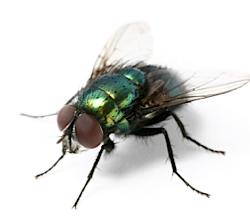
 Here is a question to the blog clinic from Richard (not his real name) who is a landlord
I have become embroiled in a dispute with my tenant and need some advice please.
I have let to the tenant since 2011 but last week she called me to report that she has come home from holiday to a fly infestation.
I politely told her that the problem must be the result of something she has done such as letting food rot in the bin while she was away. I told her that I would not be arranging pest control.
The next day I had a phone call from the council telling me that I had to sort it under the housing act health and safety system and if I refused then I would be fined.
I tried to argue but they would not listen reminding me about landlord duties and keeping premises free from infestation and disease.
I had no choice but to arrange pest control and told the tenant I would be sending her the bill. She has refused to pay and blames the problem on ‘dirty drains’.
This is clearly down to the tenant, can the council make me do this when it is blatantly her fault?
I really don’t see why I should have to pay for her poor hygiene.
Answer
The answer to the question ‘are you liable for dealing with the fly infestation’ really depends on why it occurred.
- Was it down to the tenant letting food rot in the bin?
- Or was it down to something being wrong with the drains, as the tenant alleges?
If it was a rotting food issue then, as you say, this cannot be down to you. For a start you do not have the right to access the property when the tenant is not there, for example to ensure that bins are emptied properly.
If it is down to the drains, then again you need to ask why the problem has occurred? Is it because of something the tenant has done or is it something else?
Housing, Health and Safety
Local Authorities will often go out to properties, when asked by tenants, to carry out what is known as a Housing Health & Safety Rating Survey. Here they will assess the property against 29 hazards, one of which relates to pests and infestation issues.
If the property has a ‘category one’ hazard’ then the Local Authority will, if the landlord refuses to deal with it, issue an improvement notice requiring works to be done and the landlord can be prosecuted if this is ignored.
However from what you say it sounds as if the Council Official may not actually have done an inspection. He may just be trying to ‘resolve the issue’ quickly – as clearly a fly infestation is a health and safety issue.
What to do now
You have now arranged for pest control – so you need to ask them to let you know what, in their option, was the cause of this issue and act accordingly.
If it was something out of the tenants control, then just pay the bill and leave it at that.
However if it was down to the tenant, then I suggest you get this in writing from the pest control people and then contact the tenant asking for payment – as the inspection shows it was her fault.
If she refuses to pay, then make sure you keep this report, and make a deduction from the deposit when she leaves at the end of the tenancy,
If she challenges the deduction, and the matter goes to adjudication, you will be able to produce the report which the adjudicator will probably accept as evidence for your case.
“However from what you say it sounds as if the Council Official may not actually have done an inspection.”
Nor, it seems, the landlord; who has been very quick in blaming the tenant without proof. If you want your tenants to play ball it just helps to lead by example.
A fly is not just a fly, you know. There are a lot of different species, and the fact that your tenant has recently seen a lot appearing all at once means that either they have bred up on a transient food source that has now gone, or that they are hibernating.
A food source could be something as stupid as a rat which has died in close proximity to the house and provided that food source, and this is a credible source. Round about this time of year, with the weather getting colder, rats that were living out in the fields will be feeling the cold and running out of natural food, and moving towards man-made buildings.
As most councils and other places routinely put out rat poison boxes, this means that these migrating rats will be finding the ratbait boxes, eating it and dying from it, and may well be dying inside buildings.
On the other hand, the flies might just be harmless cluster flies which are earthworm parasites as larvae, and overwinter as adults, sometimes in very large numbers in houses.
Go find some dead flies and identify them, then you can find out what the larvae are breeding on, and do something about it.