
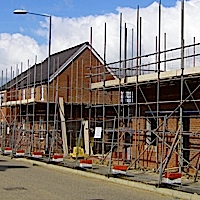
 And what can be done about it
We have a housing crisis. I have written about this before, but there is no harm in writing about it again.
There are basically four options for people wanting somewhere to live:
- Renting a room in someone’s home – the lodger solution
- Renting property in the private sector
- Buying your own home, or
- Renting in the social housing sector
Option 1 is good for a single person (or possibly a couple) on a short term basis. However it is obviously not suitable for families and for most people is not a good long term solution
Option 2 is becoming increasingly important. There are a lot of good points about the PRS and many of the properties are of excellent quality. However being in the private sector, rent levels are subject to supply and demand and in many places, for example, London, are becoming unaffordable.
There is also the problem that there is usually no long term security of tenure, although in fact most landlords will be happy to renew tenancies so long as tenants pay their rent and look after the property.
Option 3 is most people’s preferred option but the high price of property means that for people on modest incomes it is an impossible dream.
Option 4 is, therefore, the best chance for ordinary families on modest incomes to have an affordable home with long term security.
However this government seems hell bent on dismantling the social housing sector.
What is happening in our cities?
The main problems are to be found in big cities, in particular London
- Not enough new properties are being built
- Those which are being built are often being sold to overseas investors rather than ordinary people
- Social housing is being reduced due to right to buy – with around 30-40% of these properties ending up in the hands of private landlords
- It is increasingly difficult for Local Authorities and social housing landlords to replace the properties sold
Another problem, which is less publicised, is that there are not enough skilled construction workers, or indeed enough bricks, to build the properties that we need.
The lack of genuinely affordable housing is going to result in real problems if there is no-where for the lower paid people who keep our cities running (such as cleaners, waiters, firemen, teachers) to live.
This is already a major problem in Oxford as well as London.
What can we do about it?
Lets take a look at the options I identified above:
Option 1 – the welcome increase in the rent a room tax allowance will encourage more people to rent out rooms in their homes – so hopefully this will increase and help ease the housing crisis by providing more places for single people to live.
Option 2 – most PRS properties are owned by ‘small landlords’ investing in one or two properties. These landlords often provide good quality homes but there are all too many problems with ‘amateur landlords’ failing to understand or comply with the increasingly complex regulation in the PRS.
There is also the problem, particularly in large cities, of criminal landlords renting out substandard homes. The main reason why these flourish is that their tenants have no-where else to go.
There need to be more professional landlords and more ‘build to rent’. Surely business can be encouraged in invest in the sector? Why is the Chancellor not doing anything about this?
Option 3 – Although home ownership is obviously desirable, in the current crisis, I think that too much effort and energy is being expended on promoting home ownership at the expense of rented accommodation. It may be a basic human right to have a home but this does not necessarily mean a human right to own it.
Option 4 – If we, the tax payer, are to fund housing in any way, I am strongly of the view that the housing our taxes fund should remain in the public sector and be available to house other needy families once the current occupiers no longer need it.
Not sold off to be a ‘windfall’ for some lucky person – who is already lucky to have social housing in the first place.
I would suggest the following:
- The right to buy should be cancelled with immediate effect
- Government should fund (or at least encourage) a major social housing building initiative and
- this should be coupled with apprenticeships and training to encourage more young people to go into the construction industry
There is also the question of empty properties – more should be done to enable these to be taken over or compulsorily purchased by Local Authorities (in a way that is affordable for them) so that they can be used for social housing.
Finally – this article in the Economist suggests that one way around the shortage of bricks and brickies is to consider alternative methods of building. ‘Pre-fab’ housing has a poor reputation in this country but some of the Grand Design programs show that actually this type of housing can be of a very high standard indeed.
What do you think about it all? What are your recommendations?
Watching the Commons debate of the Housing & Planning Bill yesterday and reading your comment that RTB should be cancelled I suspect that you are some sort of dangerous lefty hell bent on stopping hardworking aspirational people from having the right to own their own home that they can care for and cherish. Social housing merely featherbeds the feckless who have no intention of looking after themselves and keeps them in poverty….
In the real world a family of a couple one working full time and one part time on moderate wage jointly earning £30k will be expected to pay an increased rent for their social home.
Those earning more than that living in a socially rented home able to raise a mortgage will be given a benefit of up to £104k (or £78k outside London) in in order to own their own home and then extra reward as property prices increase.
So the poorer will be subsiding the less poor!
I think it is a good thing that most landlords are small landlords: more competition and tenants can benefit from having a personal rapport with their landlords.
Tenants do not usually like dealing with large letting agents and I think they wouldn’t like dealing with large corporate landlords.
Moreover, once the local market is in the hand of one or two large landlords there is no longer any competition and a tenant having a dispute with his landlord may find himself effectively locally blacklisted.
As for social housing, I believe that the median income for a couple is about £27,000 pa. Thus, social income should only be for people earning significantly less.
Foreign investors can encourage construction of more units for BTL and thus can help bringing rents down in the long term.
Oops. I of course meant “Thus, social _housing_ should only be for people earning significantly less.”
You ignore the main potential source of catastrophe – which is that young people will have been so brainwashed into thinking that home owing is desirable that they will invest at the start of a protracted falling market leaving themselves in debt for a lifetime.
Home owning is NOT necessarily a good thing. A mobile flexible economy wants flexible living – after all the most vulnerable economies with the most vulnerable people (India, most of Africa) have high percentage home ownership.
The free market sorts out most things and trying to manipulate things creates catastrophe as the strains created are resolved.
So the basic premise stated at the start of your Option 3 is just wrong. You are mixing a lot of good ideas with more of the same thing that caused the problem in the first place.
@Andrew I actually agree with you – when I said ‘desirable’ I was really meaning I suppose ‘desired by the people’. I don’t think it is necessarily right in all cases, although will be in some, maybe many cases.
However in this country there is a tendency to assume that it is always best, which is not the case.