
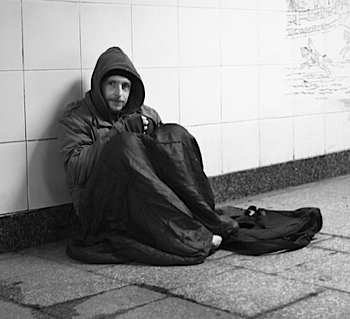
 I started my housing career as an 18 year old, working as a bouncer in a doss house.
Not an auspicious start for someone who ended up plying his trade in housing law but everyone gotta walk through the door into a room somehow.
From the get-go, you stop seeing street sleepers as an embarrassment and get to know them on a first name basis and hear the stories of how they got there, which scarily remind you that, there but for the grace of god…………..
I long ago swapped the frequent black-eyes and the occasional bloody nose for the elevated status of writing homelessness strategies for local authorities, something I am currently engaged upon for a set of councils in the South-West of England.
I’ve followed the progress of homelessness from a fight outside a toilet to being asked to interpret government policy for councils. A holistic view if ever there was one.
What struck me, even in the very early days is that society’s approach to homelessness is very skewed and often comes from the perspective that rough sleeping is a one dimensional social problem with a one dimensional cure.
As mad as it sounds to most people some homeless people find life outside the system preferable to life inside. The older I get, in a world controlled by Trump and May the more inclined I am to agree.
But where do we get our impressions about the homeless from? On what do we base our understanding? What data do we use?
It’s bigger on the inside
The first thing to understand is that the homeless are not just the people in the sleeping bags. There are also the hidden homeless, people sofa surfing, single people living in squalid and overcrowded conditions, people not picked up by the data collection systems, which if properly diagnosed would demonstrate that homelessness is a far bigger problem than is acknowledged, even in the sympathetic press, simply because the data systems are inadequate.
(Don’t worry, I’m getting to a landlord/tenant related angle soon)
Periodically all the councils in the land carry out a rough sleepers head count based DCLG criteria outlined in the following way:-
“People sleeping, about to bed down (sitting on/in or standing next to their bedding) or actually bedded down in the open air (such as on the streets, in tents, doorways, parks, bus shelters or encampments). People in buildings or other places not designed for habitation (such as stairwells, barns, sheds, car parks, cars, derelict boats, stations, or “bashes” which are makeshift shelters, often comprised of cardboard boxes).”
In order to ensure that every council is on the same page the same criteria is used based on:
- An actual – out there on the night head-count.
- An estimation, based on contacts with police, charities, faith groups, refuges etc.
But only 22 councils carried out a head-count in the last survey, the remaining 282 opted for the cross-team intelligence-based approach.
Lest you think the 282 were going down the route of less work, bear in mind that it is far easier to conduct a headcount in Westminster than in say, Hereford, where the homeless are more likely to be in tents located in woods than sitting in front of Starbucks in an obvious manner. Rural head counts are always nye on impossible to conduct
The Counting Criteria
This evident failure in the approach was picked up by many, including Crisis as no way to gather reliable data. This criticism has been accepted by government who said in their 2016 report on rough sleeping:
“The UK Statistics Authority declared DCLG’s Rough Sleeping statistics to not to meet the standard to be regarded as National Statistics in December 2015
And as a result, in September 2016 the government issued a new set of counting criteria:
“The definition of rough sleeper has been expanded. The definition of what constitutes being “bedded down” has changed to include rough sleepers about to bed down (e.g. sitting or standing near their bedding but not actually lying down). The definition includes people in tents (not on campsites or on organised protests).”
Fine for the ‘on the ground head count’ but not for the estimates. You can involve police and faith groups all you like but nobody is going to submit reliable figures based on whether or not someone looks sleepy and is sitting 2 feet from a sleeping bag.
The reliable data
All this Kafka-esque madness helps government muddy the true figures on homelessness but what of the reliable data?
Councils bear the brunt of homelessness applications and have to send back monthly figures to the DCLG, known as P1Es, on the cases they have seen and what duties they owed to them and on these figures government policy is based.
This data, which is not an estimation, shows an inarguable rise in homelessness since 2010, in fact 275,000 homelessness case actions in the financial year 2014/15 alone, a 34% increase on the year 2009/10.
The causes of homelessness
The causes of homelessness are difficult to quantify.
Back in 2002 the government conducted a survey and found that the most common background of rough sleepers was ex prison, ex-armed forces and having been in the care system at some point so the rules on priority need for homelessness units were amended and these new categories were added to the mix.
A fact that I doubt any sane person would have an issue with but what has happened since 2002?
Well the reliable figures, not the estimates, document that over the past 5 years the numbers of people claiming homelessness assistance because of the bringing to an end of an Assured Shorthold Tenancy has quadrupled from 4,600 to 16,000.
As a proportion of all statutory homelessness acceptances, loss of a private tenancy, therefore increased from 11 per cent in 2009/10 to 29 per cent in 2014/15. In London, the upward trend was even starker, homelessness consequent on the ending of a private tenancy accounting for 39 per cent of all acceptances by 2014/15.
Now before landlord readers accuse me of accusing them of driving the homelessness crisis let me acknowledge that the statistics as gathered don’t tell us why possession was sought. Section 21 is, as we all know, the “No fault ground” so statistically there is no way of knowing whether the real driver for the possession application was
- rent arrears,
- an opportunistic chance to increase rental income or simply
- the landlord wanting the property back.
The figures as gathered also don’t tell us how many landlords are just selling up.
However the simple stats show an astonishing increase whereby the background stories of the homeless of 2002 are dwarfed by the new figures recording the ending of ASTs under s21.
What we need now
The criteria for P1Es only records the reason for a homelessness application being the ending of an AST but I am urging, through the homelessness strategy I am drawing up, that the commissioning councils start delving a bit deeper than the P1E criteria requires them to do, so that a fuller, more accurate picture can be painted for why homelessness has increased a staggering 39% just on the ending of ASTs alone.
Whatever your views, mine included, they would only be anecdotal and guesstimates. But one thing is for sure, the ending of ASTs is currently the biggest driver for homelessness and that can’t be right, whatever the true cause.
I am dismayed that private landlords are getting blamed for homelessness, it might be true in London or other places, but in my own town the private landlords seem to be the only people trying to put roofs over their heads, with the DWP/Council doing the best to stop us.
We have two Landlords which some people would call rogue landlords, who home these people in very basic one room accommodation, once they have got there benefits etc. sorted can move up the ladder.
There are some homeless that do not want any roof over there head, we cannot help them.
Local organisations are homing groups over the next month and Christmas with the idea of trying to get them accommodation on the horizon if it can be done.
I had two cases in the last six months where the problem was they were not getting as much benefit as they needed/entitled too, both families had new born, the council told me not to issue section 21’s. They could not see why I could not let them stay rent free until they could sort it out.
To me Private landlords have just become scapegoats to be blamed for everybody else’s failings, and they are tarred with the same brush.
ALL LANDLORDS ARE ROGUES AND GREEDY
Only 22 Councils actually did the job they were supposed to do. There are 32 London boroughs alone, so at least 10 couldn’t be bothered to do the work they’re so handsomely rewarded to do, and I dare say your old chums at LB Lewisham are one of the ten, after all “work” is the most abusive word you can use towards their staff.
The rest used a “cross teams intelligence based approach” which translated means “we’ll sit on our great fat backsides in the office and take a guess at the number”. BR-L, consistently making excuses for the lazy Local Authorities.
Oh well I knew someone would do it.
Please re read the piece Hoglet. I specifically said I’m not blaming landlords the whole point of what I wrote there is to raise the issue of the increase of homelessness through the ending of ASTs and how there isn’t any evidence as to why.
I did not say you are blaming landlords it is the media as you said statistics, statistics dam statistics.
My point is there are problems with homelessness in some areas it is worse than others, but in areas where there are people genuinely trying to make the problem better are blamed and the very people who should be solving the problem are putting walls in the way.
Remember that no landlord leaves a property empty, therefore every time an AST is ended with a S21 another tenancy starts, or the property is sold. Hence each person that becomes homeless, results in another person being housed. But you can’t keep increasing the population without building more homes…..
I expect that more S21 are being enforced, as it is now a lot harder for some tenants to find a new home due to most landlords no longer being willing to take “high risk” tenants. (Recent changes to law and policy has made most tenants on benefits high risk.)
I have seen no evidence that landlords are asking more tenants to leave, just that more tenants are not leaving when asked.
We not only need an increase in social housing provision but more Supporting People type actions. It is difficult to maintain a tenancy for those groups which you identify – ex prisoners, ex forces and those with mental health issues. Apart from a few specialist housing associations there is precious little provision.
As a former local authority homeless officer I know that the causes are many and varied but the solutions are being either ignored or seriously underfunded. With the economic melt down of Brexit it is highly unlikely to become a priority in the next decade.