
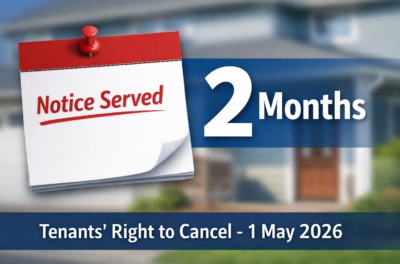
 One of the things which is worrying landlords is that after 1 May 2026, when the Renters Rights Act stage 1 comes into force, tenants will be able to end their tenancy from day 1.
This is because the Renters Rights Act will convert all assured fixed-term and assured shorthold tenancies to assured periodic tenancies and prohibit fixed terms.
It has also amended the Protection from Eviction Act to provide that tenants must give a longer notice period when giving Notice to Quit – two months.
As there is no fixed term, they can do this from the day they move into their property if they decide they don’t want to live there any more.
So how can landlords deal with this?
My first tip – guard against tenants renting as a holiday let
One of landlords’ fears is that, as rented accommodation tends to be cheaper than holiday accommodation, tenants will use accommodation intended for people’s homes and just give notice to quit on the first day.
I think this is probably unlikely. Few people can afford to go on a two-month holiday. Particularly if they have to pay five weeks’ worth of rent up front as a deposit, along with a holding deposit. They will also be legally liable for the rent for the entire two-month notice period.
Careful referencing is key here, and always meet applicants before agreeing to rent to them. You will probably spot those who just want a cheaper holiday.
However, if you think this is a real possibility, perhaps because your property is in a prime holiday location, consider renting it unfurnished. Many genuine tenants would rather use their own furniture anyway, and few holiday makers will want to spend their holiday in an unfurnished property!
My second tip – make your tenants want to stay
The main reason the government have insisted on abolishing fixed terms is to prevent the situation where tenants are forced, having signed a 12 month fixed term tenancy, to stay in a property they have discovered is substandard.
However, if your property is in excellent condition – why would they want to leave? Good properties are, in many areas, at a premium, and your tenants will probably feel grateful that they have found somewhere decent to live.
So:
- Make sure the property is in tip-top condition when they move in
- Always respond promptly when they report a problem, but
- Otherwise, leave them alone (apart from your regular inspection visits)
My third tip – dealing with tenants who fail to move out
Another problem which happens sometimes happens is that tenants serve a Notice to Quit, telling you that they are moving out and then change their mind.
This can cause all sorts of problems, particularly if you have tradespeople booked to go in to do work and new tenants lined up.
However, after 1 May, tenants will not be able to unilaterally cancel their Notice to Quit. It can be cancelled, but only in writing and only if you and any other tenants agree.
So if you are fed up with these tenants anyway (this may not be the first time they have messed you around), you can refuse to accept a withdrawal of their notice.
This means that the tenancy will end at the end of their notice period, and you will then be able to evict them on the basis that their tenancy has ended and they have not moved out.
You need to deal with this situation properly and be careful to avoid inadvertently creating a new tenancy by accepting rent after the notice to quit has expired.
We have a lot of guidance on my Landlord Law site on this point, along with guidance on the eviction process.
And finally
The right of tenants to end their tenancy early may not be the problem that many landlords fear.
Few tenants will want to move out of decent accommodation. So, good landlords who care for their properties should be fine.
If tenants do serve a notice to quit and you are unhappy with them as tenants anyway, this will be an opportunity for you to evict them if they don’t go.
The real problem with the loss of fixed terms will be for student landlords, and I wrote about this here.
Can a tenant give 2 months notice to terminate the tenancy on May 1st? Or does two months notice have to end on the end of a rental month?
E.g. If a 12 mth contract started on 13th January 2026 does the 2 mth notice need to be given by a tenant on say 13th May 2026 or can he give it on May 1st?
My understanding is that the notice must end at the end of a rental period, but the legislation does not actually say this.
I suspect it will incorporate the common law rule, but we will have to wait and see what the courts say if this is challenged.
If this does apply, then it’s not the date that the notice is GIVEN which is restricted; the tenant can serve the notice on any day, it is the date the notice period EXPIRES. So the notice period will be between 2 and 3 months, depending on when in the month it is served.
So, yes, the notice can be given on 1 May, but the notice period may be longer than 2 months.
A practical reminder that in a more flexible tenancy landscape, keeping tenants happy may matter more than trying to lock them in.
Absolutely! As per my second tip. Research shows that the most successful tenancies with tenants staying longer tend to be where the tenants are happy with their landlord.
Landlords need to remember that they are providing a social service to consumers. This is not just an investment.
This is a very informative post! Understanding tenants’ rights, especially regarding early termination of leases, is crucial for both landlords and property managers. The practical tips and clear explanations make it much easier to navigate these situations fairly and legally, ensuring a smooth process for all parties involved. Thanks for sharing these essential insights!
This is really helpful and easy to understand, especially with all the changes coming in. The part about tenants being able to give notice more easily is interesting it definitely feels like things are shifting more in favour of renters now. Thanks for breaking it down so clearly
This is a very timely discussion, as the Renters’ Rights Act is set to significantly reshape landlord, tenant dynamics and investment strategies. With the shift to periodic tenancies and tenants gaining the ability to end agreements with two months’ notice from early on, landlords will need to focus more on tenant satisfaction, property quality, and operational flexibility to maintain stable occupancy . From a real estate perspective, this change moves the market toward a more service-oriented model, where long-term value is driven less by rigid contracts and more by delivering desirable, well-managed rental properties that encourage tenants to stay voluntarily.