
 The Renters Rights Act is a massive act and will change the Private Rented Sector in many ways.
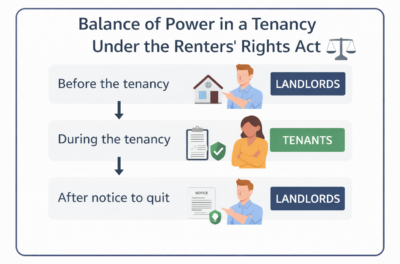
One important way it will change the sector is in the balance of power between landlords and tenants at different stages of a tenancy.
Let’s take a look.
1. Before the tenancy starts
Here, the power is with the landlord. The tenant wants to live in the property but can only do so with permission of the landlord.
So if the landlord requires the tenant to sign a particular tenancy agreement or obtain a guarantee as a condition of being granted a tenancy, the tenant will have to do this.
Unless the landlord is finding it hard to source good tenants, in which case the applicant may have more leverage to negotiate different terms.
2. During the tenancy
Here, the power, for the most part, is with the tenant.
If the landlord is unhappy with the tenant, they will only be able to evict on the grounds set out in Schedule 2 of the Housing Act using the section 8 procedure. With section 21 gone, no longer will landlords be able to evict tenants without giving a reason.
So long as there is no ground which the landlord can use, the tenant will be secure in their accommodation. Meaning that they will be able to:
Enforce their legal rights
For example, regarding the condition of the property.
For many years, some landlords have intimidated tenants by the threat of ‘retaliatory eviction’ if they dared to complain. However, with the abolition of section 21, landlords no longer have this power.
Tenants will also be able to complain to their Local Authority. After 1 May 2026, councils will be required by law to enforce landlord legislation in their area. So will be more likely to take action against bad or rogue landlords.
Refuse to sign new documentation,
For example, new tenancy agreements and guarantee deeds. Formerly, these were routinely signed at ‘renewal’, i.e., when the fixed term ended. However, with all tenancies being periodic, there is no renewal.
This will be particularly problematic for landlords whose tenants have provided a guarantee. Under a very old case, Holme v Brunskill from 1878, there is a rule that if a contract is varied without the guarantor’s consent, the guarantee will be discharged.
I have tried to deal with this by drafting a new form of guarantee, which I hope would survive changes to the tenancy, including rent increases. You can read about this here.
So far as tenancy agreements are concerned, it is now super important that landlords take care with these before they are issued. If a mistake is made, your tenant may refuse to sign a revised version.
And generally,
During the tenancy, landlords will have less power than formerly. For example to
- Impose high rent increases
- Forbid pets, and
- Dictate to tenants when they should vacate
They can still increase rent, forbid pets and require tenants to vacate, but the circumstances under which they can do this are considerably more circumscribed.
3. After service of a tenant’s notice to quit
Landlords are generally unhappy about the right for a tenant to serve a tenant’s notice to quit and end the tenancy. However, if the tenants change their mind, or if some of joint tenants want to remain, this will put landlords back in the driving seat.
This is because once a Notice to Quit has been served, the tenancy will end at the end of the notice period.
If the tenants then fail to vacate, the landlord can evict them easily on the basis that the tenancy has ended and they have not vacated. There is no defence to this claim (so long as the tenancy is actually ended).
So if the tenants want to remain and the landlord says he will only agree to this if the tenants sign a new tenancy agreement and provide new guarantees, they will have to do this.
For the landlord to retain his moment of power, however, it is essential that he does not accidentally create a new tenancy by accepting rent.
The way to do this is to say that any rent is accepted as ‘mesne profits’ and without any intention to create a new tenancy. Guidance on this tricky process is available to members of my Landlord Law service.
Landlords interested in the Landlord Law service will find more information here.
And finally
The key takeaway is that the balance of power between landlord and tenant will shift depending on the stage of the tenancy.
Understanding when you have leverage – and when you do not – will be increasingly important in the Renters’ Rights Act era.